
Costs Are Up 36%. Seafood Is Still On the Menu.
Reporting and stats referenced in this post are drawn from “Higher costs forcing US restaurants to innovate to keep seafood on menus” by Christine Blank, published in SeafoodSource’s Foodservice & Retail section, July 23, 2026.
Restaurant operators have been squeezed from every direction. Labor, food, utilities, occupancy, credit card fees, all of it is up sharply since 2019. According to the National Restaurant Association, total operating expenses for the average U.S. restaurant have climbed 36 percent between 2019 and 2026, driven by a 41 percent jump in hourly wages and a 35 percent increase in wholesale food prices.
Seafood hasn’t been spared. Shellfish entree prices rose 6 percent in Q2 2026 versus Q2 2025, and fish entrees were up 3 percent, per Datassential. So, the obvious question for any operator is: with margins this tight, is seafood still worth the real estate on the menu?
The operators who are actually managing this well have a clear answer: yes. But how they’re doing it says a lot about what should be on every menu planner’s radar right now.
Cutting the Dish Isn’t the First Move
Matt McMillin, chief culinary officer at Cooper’s Hawk Winery and Restaurants, put it plainly to Restaurant Business: “I’ve never before seen the convergence of these forces in the industry.” Even so, Cooper’s Hawk has held the line on seafood, with one exception. When scallops became too cost-prohibitive, the chain didn’t pull them, it re-engineered the dish, folding scallops into a shrimp risotto so guests weren’t hit with the full price jump of a standalone scallop plate.
Note: That’s the pattern worth noticing. Operators aren’t retreating from seafood. They’re getting smarter about how they serve it.
The Math Behind “Surf and Turf”
Restaurant consultant John Gordon of Pacific Management Consulting Group frames it as a straightforward upsell opportunity: “If you can move people from a $10 plate of spaghetti to a plate with seafood, especially shrimp, you can get that up to $20.”
Pairing seafood with a lower-cost base protein or starch isn’t a compromise, it’s a margin strategy. Pokeworks’ new High-Protein Surf & Turf Bowl, which pairs ahi tuna with chicken breast, is a live example of the same idea in action.
Reliable Sourcing Is the Real Lever
For Another Broken Egg Cafe, the strategy has been less about substitution and more about supplier partnerships. The chain recently upscaled its seafood lineup with dishes like a Champagne Lobster Omelette and Low Country Shrimp and Fried Green Tomato Benedict, leaning into the idea that “seafood delivers [something] that feels both indulgent and approachable,” Joel Reynders, VP of Culinary and Corporate Executive Chef, told SeafoodSource.
Note: Reynders credits close supplier relationships, not menu cuts, with keeping ingredients like langostino affordable even as fuel costs, tariffs, and broader seafood inflation push prices up.
This is exactly the case we’ve been making around Cape Haddie’s supply stability, and this article shows it playing out industry-wide: the operators staying committed to seafood are the ones who’ve locked in dependable supply, not the ones chasing the cheapest spot-market price week to week.
One Portfolio, Every Cost Pressure
The reality is that no single product solves every version of this squeeze. That’s exactly why Southstream carries five distinct brands, not one:
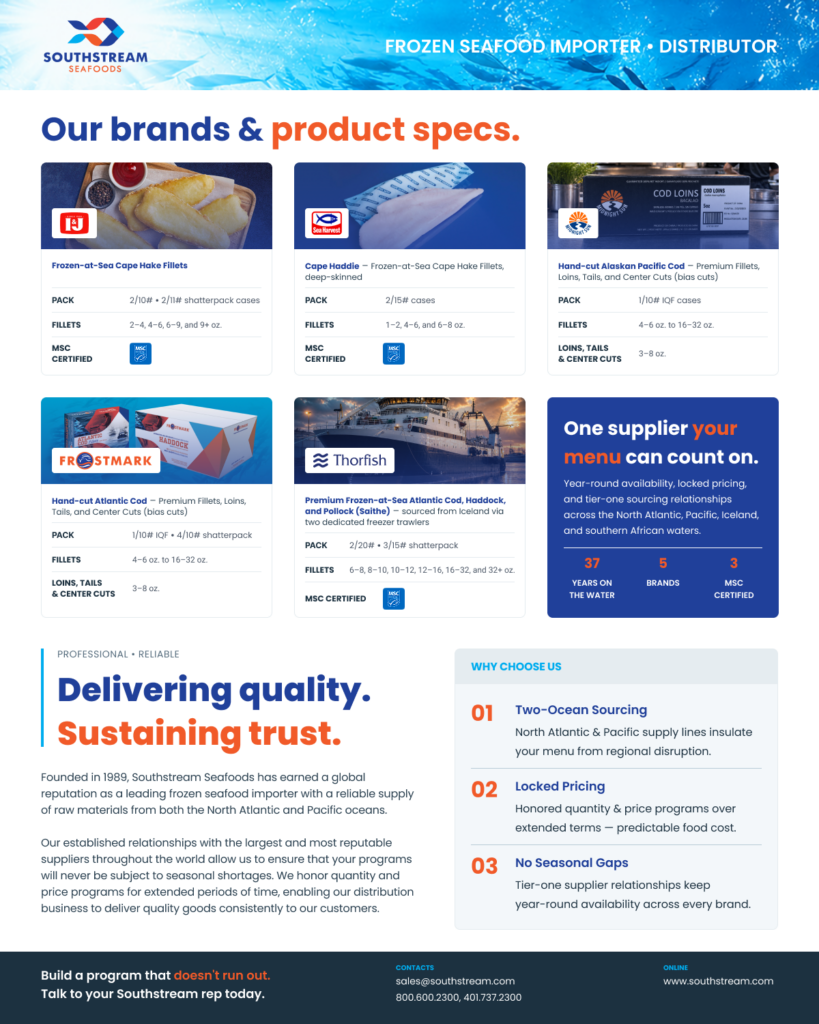
- Frostmark and Thorfish for the operators who need dependable, consistent whitefish supply they can build a menu around without re-negotiating sourcing every quarter.
- Sea Harvest and I&J for menu engineering plays, pairing quality whitefish with lower-cost bases, to keep seafood accessible at a defensible price point.
- Midnight Sun for the elevated, special-occasion positioning Another Broken Egg is leaning into, where seafood signals quality precisely because everything else on the menu is being cost-engineered down.
Whatever the pressure an operator is managing, sourcing, margin, or menu positioning, there’s a brand in the portfolio built for it.
37 Years of Weathering This Exact Cycle
Cost cycles like this one aren’t new. What’s changed is how sharply they’re converging right now. Southstream has spent 37 years building supplier relationships precisely so that operators don’t have to choose between keeping seafood on the menu and protecting their margins.
The operators quoted in this piece figured out the same thing we’ve believed all along: seafood doesn’t have to be the first thing cut when costs rise. It just has to be sourced right.
Looking Ahead
Partner with us as we understand these ongoing challenges. At Southstream Seafoods, we don’t just supply seafood — we show up, deliver consistently, and stand shoulder-to-shoulder with the businesses that power this industry.